ERRANT HELICES / CHRISTOPHER COZIER & SHANNON ALONZO
Back
More information: scroll for Antawan Byrd's text



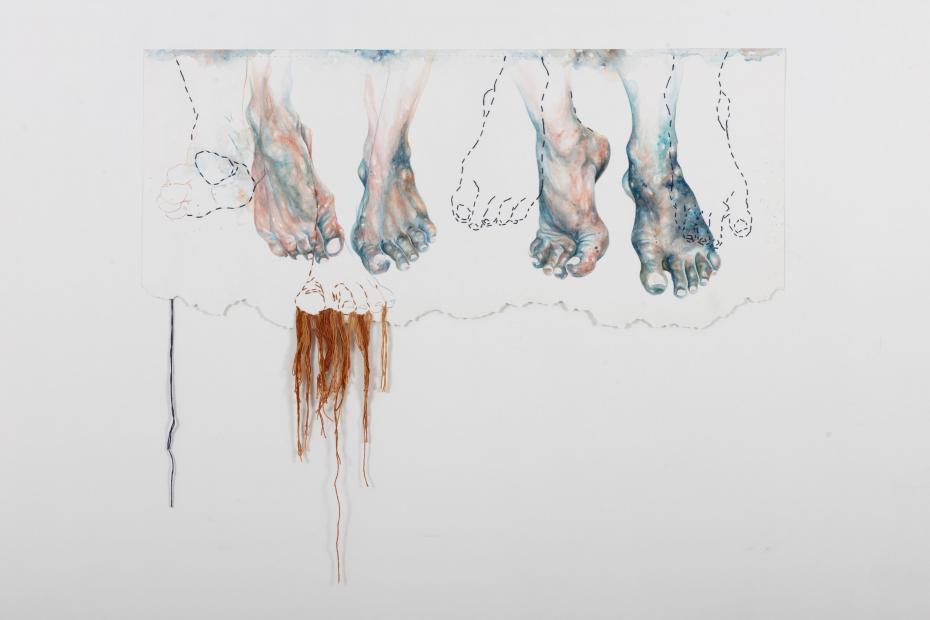
Errant Helices / Christopher Cozie & Shannon Alonzo
Helix (plural, Helices). Anything of a spiral or coiled form, whether in one plane (like a watch-spring), or advancing around an axis (like a corkscrew), but more usually applied to the latter; a coil, a spiral, as an electromagnetic coil of wire, the thread of a screw, a tendril, etc. (Oxford English Dictionary)
The helix form contains opposing forces. On the one hand, what provides stasis to the form is its readily recognized and therefore classifiable coiled or spiraling structure; on the other, the structure conveys dynamism, a spiraling movement away and outward, almost as if it could extend itself indefinitely. While engineered uses of the helix, such as in coils or screws, purposefully limit the extension of its form to accomplish proposed functions, the form in the natural world, such as in a tendril, organically sustains and augments the form’s outward growth. At its most rudimentary in nature, the twisted ladder form of DNA’s double helix—the genetic foundation of what makes us, us at a molecular level—holds identifiable, inherited properties and transmits them reassembled to forthcoming generations through reproduction. In its stasis and dynamism, the helix possesses both diachronic and synchronic properties. It is a form that reveals how it materializes in a particular moment and over time.
Titled Errant Helices, this exhibit displays selected works by the Trinidad and Tobago-based artists, Christopher Cozier and Shannon Alonzo. Helices in the art on display depict entangled relations between humans and the natural or surrounding world at precise moments and through time. These relations do not oppose “man” to “nature,” as Romantic antecedents strategically did to give rise to reflections on the inescapable embeddedness of “man” in “nature.” Rather, the helical forms in this art foreground the twisting, inextricable entanglements of humans and the surrounding world as preconditions for creating art. As a point of departure, this entanglement is familiar to artists and intellectuals in places where colonial histories have long documented the efforts of imperial projects to subdue natural and precolonial human environments. Hence, each artwork not only provides a statement about this entanglement of humans and the surrounding world at a given moment but each also employs specific citations and objects to substantiate its intervention and situate it contextually.
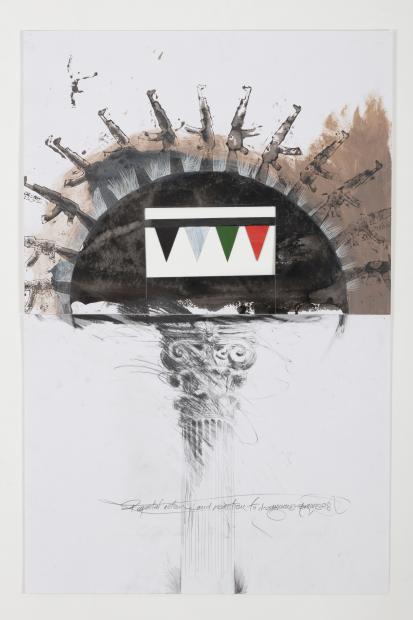
Cozier’s central piece, Stepping, foregrounds the explosive, centrifugal emission of red and black helices from a megaphone to convey the artist’s introduction to, engagement with, and celebration of Pan-Africanist thought through popular music. Modes of stepping—back and forth, processional, celebratory, or combative movements—respond to this music. Depicted in Pan-African colors, the helices propose a visible rendering of sound waves that were both specific to the music of the artist’s generation and historically revolutionary in the creation of evolving sonic and ideological spaces. At their most rudimentary, the helical forms evoke the transmission of musical sounds through the atmosphere. Yet, like DNA’s double helices, they also emerge from and capture through citations and riffing the unique properties and legacies of the specific cultural figures, thought, sports, musicians, and songs that contributed to the artist’s conception of Pan-Africanism.
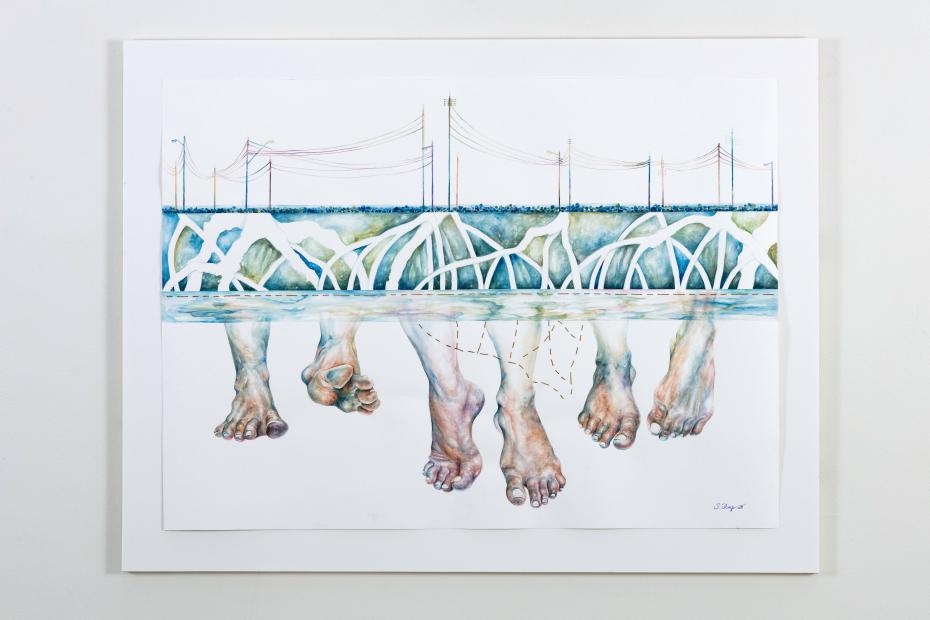
In Alonzo’s works, the simultaneous presence of mangrove (Lat. Rhizophora mangle) roots and human feet provides various renderings of always evolving, borderless entanglements between two temporalities of progressive movement: the organic, ahistorical advance of mangrove roots that create, expand, and protect coastal lands and the human occupation of space over time, ranging from walking or dancing to proprietary or anthropocentric claims. In works like Point of Contact, these temporalities are competitive and produce ruins or remnants in the wake of their ongoing entanglements. In other works like Grounding , the outgrowth of feet from mangrove roots fuses natural and human temporalities into forms that are aspirational, mythical, or monstrous in their amalgamation of DNA properties.
***
Errant. I. Itinerant, traveling. II. Straying, wandering, erring. (Oxford English Dictionary)
In the works selected for this exhibit, “errant” not only alludes to the dynamism of the helix’s spiraling forms as they wind into open, borderless spaces, but, more significantly, the term directly refers to Alonzo’s and Cozier’s creative processes.
Errant is the opposite of teleological. As a questioning of the faith-based certainty of the European Medieval pilgrim’s itinerary of steps to and from known sanctuaries, errancy has constituted a commonplace in modern art and literature since the Renaissance. Further informed by the historical, late 15th-century events of stumbling upon an American continent and indigenous peoples that were never mentioned in the Scriptures, errancy came to embrace anthropocentric notions of exploration and discovery, in their most aspirational conceptions, and shipwrecks, straying, and loss in their most nihilistic. From Baroque art to the historical avant-garde movements, errancy in the modern era is not deterministic but opportunely or tragically accidental.
While remaining in conversation with thematizations of errancy in modern art, feet and stepping—which semantically include ambling, wandering, marching, shuffling, running, dancing, jumping, and so on—locate errancy in these exhibited works as instrumental for reception, citational practices, and artistic production. In Cozier’s Stepping, for example, the artist cites cultural figures, objects, music, musicians, and songs that contributed errantly, that is, obliquely, incidentally, extemporaneously, coincidentally, or accidentally to his non-teleological reception of and engagements with Pan-Africanism. A uniquely personal collection of Pan-Africanist references, including some of his own creation, and rendered accessible through a legacy of citations and riffs, Stepping documents how Cozier received, cultivated, and celebrated his knowledge of Pan-Africanism. Alonzo’s collection of bare feet cites and contributes to a modern tradition of anatomical drawings. Yet featured on paper in a context of mangrove roots, fences, and other manmade structures and devices, and stitched in the form of feet, punctured by stitches, or stitched as prosthetic appendages to the objects that surround them, these feet constitute a lexicon of pedal attitudes. Ranging from immobility to stretches, twitches, or feet caught in movements like walking or running or hanging still, these attitudes provide a language for expressing the affects and risks of errancy.
“Errant” also describes Cozier’s and Alonzo’s creative processes. Both artists conceive errancy not only as a predisposition for receiving and citing references and influences but also as a process for creating art. For them, errancy’s dynamism provides opportunities for correction, self-correction, or changing direction as they give tangible form to their artworks. For Cozier, the capacity to change course or directions is not only inherent to stepping as physical movements forward, backward, or sideways but also in the creation and evolution of Pan-Africanism’s sonic and ideological spaces. According to Alonzo, the stitching in her works does not necessarily follow the perforations on the paper that she initially planned and made but may deviate as her manual activities supplant, supplement, or modify the works’ cognitive conception and design.
As an exhibit, Errant Helices is neither programmatic nor interested in offering a manifesto. So teleological or didactic an endeavor runs counter to its artists’ conceptions of the works they’ve created. Rather, the artworks that Cozier and Alonzo display here demonstrate a range of complementary and contextualized creative statements in which inextricable entanglements and errancy do not constitute unsurmountable, poststructuralist challenges to artistic creativity but condition their possibilities. Visitors are invited to contemplate the works of the artists errantly: that is to say, wandering, meandering, and ambling from work to work in the exhibit.
Gerard Aching
__________________________________________________________________
Reflections on Christopher Cozier’s Stepping (2024)
The children’s game of hopscotch proceeds in a fairly rudimentary way. With chalk or some other mark-making material, you draw a course on the ground composed of squares organized side-by-side, each inscribed with a single number from 1 to 10. You toss a small object onto the first square without touching the lines, and from there you begin hopping: one foot into single squares, and two feet in the double squares. This rhythm continues until you reach the end of the course with the square marked 10. From here, you turn around and essentially repeat the process after marking the next number in the sequence.
Knowing of Christopher Cozier’s abiding and critical interests in histories of colonial pedagogy and the material trappings of independence-era education, hopscotch is one of the associative references that comes to mind when I think about the artist’s Stepping (2024). Its name calls up travel and territorial exploration, as the word scotch—meaning to scratch a surface— describes the boundaries through which the game’s movements are organized. Stepping recommends these associations in part because of its fundamental reliance on the grid as a structure of presentation. Like several of Cozier’s installations over the past two decades—most notably his magnum opus Tropical Night (2006–14), and more recently his installation Turbulence (2019–2021) for the Liverpool Biennial 2021—the nearly three dozen individual drawings that make up the core of Stepping are presented in a neat and orderly fashion. The installation’s wall elements appear in a roughly 4 × 9 sequence, marked by several gaps where no individual drawings appear. And the installation assumes three dimensions through the presence of a large and intertwined network of drawings of helix forms, which, suspended from high above by lines of translucent monofilament, physically cast shadows over the drawings.
If hopscotch requires the player to move through a predetermined sequence, Cozier’s Stepping proposes something less prescribed. It offers the viewer a sequence of possible movements, inviting them into a game of travel, whereby the gaze moves from one drawing to the next, skipping over some spaces, only to land on others. Yet unlike the playground game, whose numbered squares recommend a particular route, Stepping requires no predetermined path through its network of drawings. Intervals in the sequence that register the presence of the gallery wall introduce pauses and interruptions that feel as significant as the drawings themselves. By inviting a range of routes and associative links between the various images, Stepping models the wayward trajectories that have long defined encounters with and investments in Pan-African thought.
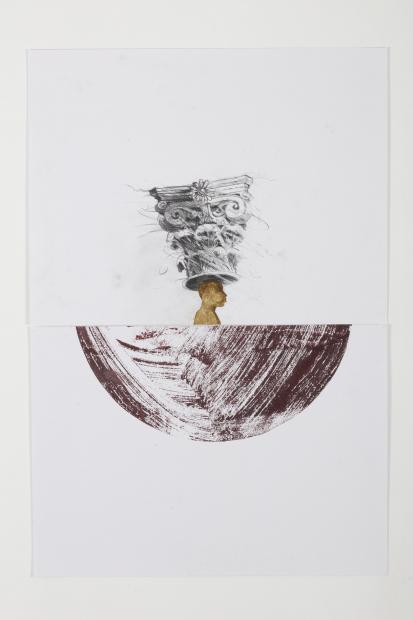
Perhaps nowhere is this more potently legible than in the installation’s first two columns of drawings, in which charcoal portraits of the Trinidadian activist Henry Sylvester Williams figure prominently. Formally attired and fragmented across separate sheets of paper, these ghostly portraits point up the elusive character of Williams’s own life. Prior to establishing the African Association in London in 1897—which three years later organized the First Pan-African Conference in Westminster—Williams had already traversed a noteworthy professional and geographic itinerary. After his work as a schoolteacher in Trinidad, he later traveled through United States and Canada before settling in London in 1896. Through his subsequent work as a lawyer, political organizer, and elected municipal official, Williams moved between Britain, the Caribbean, and Africa. As historian Marika Sherwood observes, significant periods of activity throughout his life remain difficult to reconstruct, even as his activism and broader work helped shape some of the earliest transnational networks upon which Pan-Africanism would subsequently rely. In Stepping, Williams’s likeness does not emerge through a complete or stable image. Instead, it appears fragmented and in motion. Indeed, in one drawing, Cozier perches a ship atop his head, a juxtaposition that evokes at once transatlantic circulation and the optical travel that animates our experience of Stepping.
The installation’s recurrence of buntings in the colors of the Pan-African flag likewise suggests the circulation of political thought across borders, while the depiction of a Decca record and images of sound systems recall the movement of dancing bodies and the technologies of sound that reproduce and circulate popular music. A lone cricketer caught mid-throw likewise calls to mind embodied movement and the entanglements of race, class, and colonial identity famously explored by C. L. R. James’s 1963 study Beyond a Boundary. Already these associative readings suggest the numerous ways Pan-Africanist ideas have circulated through the bodily gestures and rhythms of everyday life, a proposition most boldly expressed through the installation’s megaphone, from which a large, suspended configuration of intertwined helices extends in the shape of a speech bubble. Recalling the use of speaking trumpets by seafarers to communicate with ships across ocean distances, the megaphone points up histories of communication across space, while also suggesting its competing uses today in expressions of protest and state authority. The helices, meanwhile, recall the structure of DNA, figuring sound and speech as the lifeblood of collective identification, an animating force through which Pan-Africanism continues to reproduce and acquire new meaning.
As one of the curators of Project a Black Planet: The Art and Culture of Panafrica, the exhibition in which Cozier’s Stepping debuted, I have encountered the installation on numerous occasions: in Chicago, where it was first presented, then in Barcelona, and most recently in London. With each presentation came a slightly different experience of the work, shaped as much by its juxtaposition with other artworks as by my memories of prior presentations and the early sketches through which the workl developed. Encountering Stepping across three cities, I came to appreciate how its physical movement and iterative presentation carried echoes of the very histories of circulation embedded in its range of imagery. As with the game of hopscotch, which requires the player to recalibrate their position from one jump to the next, each successive encounter with Stepping occasioned different points of entry into its network of explicit and concealed references. Perhaps this is ultimately what Stepping drives home, that history never quite remains where we left it.
Antawan I. Byrd
Christopher Cozier ( → Artist Website)
/
Biography
Co-director des Kunstkollektivs Alice Yard, das an der documenta 15 teilnahm
Solo Exhibitions
Group Exhibitions
"Experiences of Oil" / Stavanger Art Museum, Stavanger
Documenta 15, with Alice Yard
"Más Allá, el Mar Canta" / The Times Art Centre, Berlin
"Fragments of Epic Memory" / AGO, Toronto
"The Sea is History" / Historiskmuseum, Oslo
Shannon Alonzo ( → Artist Website)
/
Biography
Shortlist Ashurst Emerging Artist Prize
CATAPULT Caribbean Artist Showcase Grant
125 Fund Research Grant
Solo Exhibitions
Sediments, Y Gallery, P.O.S, Trinidad
Group Exhibitions
Prospect 6 Selections, MCA Denver, Colorado, U.S.A
Hard Graft, Wellcome Collection, London, U.K.
Atlantic World Art Fair, Artsy, Y Gallery Booth
Cloud Sediments, Ambika P3, London, U.K.
Ashurst Emerging Art Prize Shortlist Exhibition, London, U.K